
KS WTMA Curriculum : TaeKwonDo ▪ HapKiDo ▪ KumDo (Sword)
Tiny Tigers (age 3~5) Children (age 5+) Teen & Adults Families
KS WTMA’s Martial Arts has one curriculum with 3 different Martial Arts features. The basic is TaeKwonDo. HapKiDo techniques are added to our curriculum for enhancing self defense techniques. KumDo (HaeDong KumDo) techniques will extend our Martial Arts discipline to weapons.
Major practice areas are;
|
Meditation / Student Oath (Mooksang) Meditation is for the purpose of concentration practice in order to focus the mind and body to work together for developing precision and maximum strength, visualizing goals and listening to the conscience for internalizing important truths and moral standards. Kicking Technique Tae Kwon Do has various Kicking Techniques. It’s hard to learn and takes time but students will learn from basic kicking techniques and principles by step by step approach. Self-Defense - One Step Sparring / Blocks is the study of how to use an attacker’s strength or skill and weapons against him or her. The practitioner learns when, how, and where to attack an assailant using "pressure points" (areas of the body that when pressed cause intense pain), grappling and joint-locking techniques and throws. Form (Poomse) Form(Poomse) is a series of movements of the various kicks, steps, blocks and techniques of Taekwondo which the practitioner perfects against an imaginary opponent(s). The performance of poomse develops concentration, balance, coordination and flexibility. The official form for competition shall be those recognized by the World Taekwondo Federation. Sparring (Gyoroogi) is the practical application of various forms against an actual opponent. In this type of competition cooperation, self-control, concentration, respect for yourself and your partner, speed, skilled technique, precision, and confidence are the deciding factors. (Students will learn safely through a step-by-step systematic method of gradually learned sparring strategies - this is easy to learn and is a lot of fun). |

|
Breaking Board Technique (Kyukpa) is done to practice and illustrate the formidable power, precision, and great mental concentration of the Tae Kwon Do practitioner. Bricks, rocks, boards, cement blocks, and such are broken since it is not feasible to use this sort of power on another person in everyday practice! Black Belt Philosophy Mental discipline as a Martial Artist including: Focus, Respect, Consistency, Goal Setting, Self Control, Loyalty, Cooperation, Enthusiasm, Perseverance, Confidence, Responsibility and Leadership Korean Terminology We use the Korean terms for many of the techniques in class. The Korean terms are used since Tae Kwon Do originated in Korea. Students will need to learn the terminology to advance in rank and they will also need to learn the terms if they plan to join a competition. Competition referees are trained to use only Korean. Most of this terminology will be taught from every class. TaeKwon Gymnastics Learn TaeKwon Gymnastics from 3 times of World Champion in TaeKwon Gymnastic Competition, Master J Weapon Martial Arts Sword Martial Arts (Haedong KumDo) - Basics & Forms Other Weapon Seminar - Nun chuck, Fan, Bo staff etc. |
1. The Ultimate Body & Mind Fitness Program
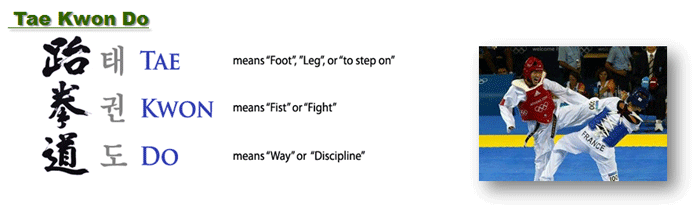
Tae Kwon Do is one of the most Systematic and Scientific Martial Arts originated from Korea. Through disciplined training, Tae Kwon Do improves both the mind and body, placing great emphasis on the development of personal character. Students are taught that self control, self discipline, kindness and humility must accompany their increased physical strength and self-defense techniques.
2. The Sport of Olympics
Today, it has become a global sport that has gained an international reputation, and stands among the official games in the Olympics. Tae Kwon Do Sparring has been selected as official sports for Sydney, Athens Olympics and also for Beijing 2008 and 2012 London Olympic Games.
3. The Most Popular Martial Arts
There are 198 member nations and about 70,000,000 people active (& more than 7,300,000 official black belt students) in training under the WTF (World Tae Kwon Do Federation, as of January 2009).
Hap Ki Do
HapKiDo (Actual Self Defense Skills) is a dynamic and eclectic Martial art. It is a form of self-defense that employs joint locks and techniques of using opponent’s power.
Hapkido contains both long and close range self defense techniques, utilizing dynamic kicking and percussive hand strikes at longer ranges and pressure point strikes, joint locks, or throws at closer fighting distances.
Hapkido emphasizes circular motion, non-resisting movements, and control of the opponent. Practitioners seek to gain advantage through footwork and body positioning to employ leverage, avoiding the use of strength against strength.
The character hap means "harmony", "coordinated", or "joining"; ki describes internal energy, spirit, strength, or power; and do means "way" or "art", yielding a literal translation of "joining-energy-way." It is most often translated as "the way of coordinating energy," "the way of coordinated power" or "the way of harmony.“
Kum Do
KumDo (Extend Martial Art Skill to Weapon) Haedong KumDo is a sword Martial Art origined Korea. Practitioners of Haidong Kumdo engage in the practice of basic techniques (kibon), forms (geompeob or pumsae), step sparring (yaksuk daeryun), sparring (hada), energy building exercises (qi gong) and cutting practice (begi). Basic form practice is done with the mokgum (wooden sword). Sparring and power practice begins with the bamboo sword (chukdo).